Appearance
AI coding agents are already good at the work immediately in front of them. Give one a clear task, answer its questions, and it can behave much like a capable junior developer: focused, productive, and ready for the next instruction.
The difficult part is everything around that task.
The Babysitting Problem
An agent usually does not know which task should come next. It may not recognize that its own work needs review, understand that another part of the plan has changed, or recover gracefully when the environment is broken. It can ask for help, but a human still has to notice the question, supply the missing context, inspect the result, and restart the cycle.
That works for one task. Over a long project, it turns the human into a dispatcher who must remain present at every handoff.
Looping scripts can keep a single agent moving serially, but repetition is not coordination. A loop can say “continue.” It cannot maintain a living understanding of the product, decide what matters now, or help several agents work at once without blocking or spoiling one another’s work.
The bottleneck is not getting an agent to act. It is keeping a body of agents moving toward the same product without requiring a human at every handoff.
Coleo exists to address that coordination gap.
A Plan Is a Living Model
A software plan is not a program that simply executes from top to bottom. It is a model of what we currently believe should happen. Work changes that model.
An implementation exposes a missing requirement. A test reveals a faulty assumption. An agent discovers a dependency. A service fails locally. A completed task makes another task unnecessary. Humans also continue thinking while the work is underway and may change direction as the product becomes more concrete.
For that reason, planning cannot end when execution begins. Coleo continually relates the plan to completed work, discoveries, questions, reports, and the condition of the working environment. The next useful task should come from the project as it exists now, not only from the order imagined at the beginning.
This is progressive planning: direction remains durable, while the route stays responsive.
Parallel Work Needs Coordination
Running more agents does not automatically create more progress. Without coordination, concurrency multiplies duplicated effort, conflicting edits, unanswered questions, and partially correct decisions.
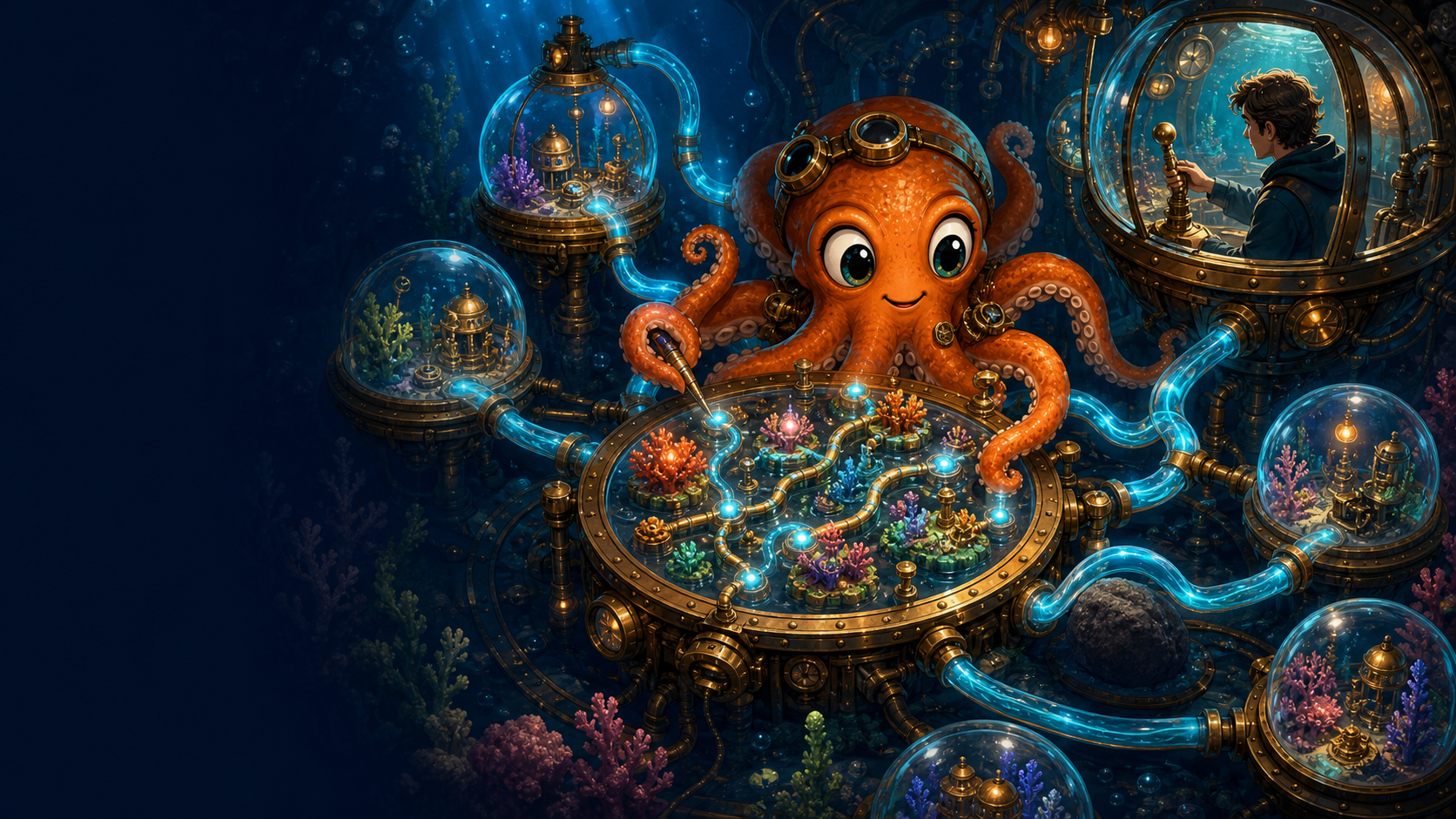
Coleo is designed so multiple arms can attack a larger plan both serially and in parallel. Each arm focuses deeply on its immediate task, while the Brain retains awareness of the wider project. Arms return reports, discoveries, and questions rather than silently carrying important knowledge inside one disposable session. They can also help one another by making blockers and shared constraints visible.
The objective is not maximum concurrency. It is productive concurrency: enough independent focus to move quickly, with enough shared awareness to keep the work coherent.
One Garden, One Shared Reality
Coleo begins with a shared working environment because the product ultimately has one real state.
Worktrees and branch-per-agent systems can isolate edits, but they also move coordination into a growing merge problem. They are difficult to reason about, easy to leave stale, and capable of hiding conflicts until the context that produced them has already disappeared.
The default Coleo workflow lets arms work in the same clone and integration history. Arms claim tasks or files when exclusivity matters, stage their changes deliberately, form commits and branches when useful, and communicate when their work overlaps. More advanced Git topologies remain possible, but isolation is not treated as a substitute for coordination.
Conflict should be made visible and managed while the work is happening, not merely discovered later at merge time.
Specialization Belongs to the Task
Coleo does not need a cast of artificial employees with permanent personalities. Arms should begin as homogeneous, general-purpose workers so that the system does not depend on a particular identity remaining alive or available.
The task supplies the temporary role. The same arm can receive the context and tools needed for development work, then review, testing, documentation, or project management. What matters is the assignment and its briefing, not a fictional biography attached to the process executing it.
This makes the system easier to recover, scale, and adapt. A stopped arm can be replaced. Work can move to another host. A different model or harness can take over without changing the project’s organizing logic.
The Human Chooses the Altitude
The human is not removed from the process. The human becomes the product manager for a corpus of agents and chooses how closely to manage it.
At one moment that may mean specifying an exact task, correcting an implementation, or answering a detailed question. At another it may mean setting the goal and constraints, reviewing checkpoints, or simply observing while the system continues. Hands-on and hands-off are operating modes, not competing philosophies.
The goal is to stop spending human judgment on mechanical handoffs so it remains available for requirements, priorities, taste, risk, and decisions that genuinely need it.
This relationship does not require recreating an entire corporate process. A plan document, email, and a few spreadsheet-like views are enough to express most of the useful work: direction, status, ownership, questions, discoveries, and decisions. Their value comes from being durable and iterative. They must change as the project changes.
Coleo borrows the minimum effective habits of a well-run development team without pretending agents are human coworkers.
Autonomy Must Be Observable
Unattended work is useful only when it remains understandable. Coleo treats observability as a prerequisite for autonomy, not an optional dashboard added afterward.
Tasks have visible state. Questions and discoveries return to shared context. Activity can be inspected. Claims show where work may collide. The human can intervene, redirect, pause, or recover the system without reconstructing events from a collection of terminal windows.
Hands-off operation is therefore not surrender. It is confidence that the system can continue while preserving the evidence needed to understand what it did and why.
Local Ownership, Replaceable Agents
Self-hosting is part of the philosophy because the codebase, execution environment, project history, and agent activity belong to the developer operating them. Long-running coordination should not require handing control of the working environment to a hosted agent platform.
Vendor flexibility follows from the same principle. Models and coding harnesses will change. Coleo keeps the plan, shared state, coordination rules, and human interface outside any one agent provider. Harnesses are adapters; they should be replaceable without replacing the system around them.
The durable asset is not a particular model session. It is the project’s accumulated intent and shared understanding.
Why an Octopus?
The octopus is useful because its arms can act locally without losing their relationship to the whole organism. Each arm concentrates on the problem within reach. The Brain does not perform every action or erase that local intelligence; it maintains enough whole-system awareness to coordinate attention, exchange signals, and respond when the environment changes.
That is the balance Coleo is pursuing: independent cognition without isolated work, central coordination without constant micromanagement, and meaningful autonomy without opacity.
From Idea to Product
Coleo is not a static job queue and it is not a simulation of an engineering organization. It is an evolving management layer for turning an idea into a functioning product with several capable agents working over time.
The plan provides continuity. Arms provide focused execution. The Brain keeps the work connected. The shared garden keeps it real. The human supplies intent and judgment at whatever altitude the moment requires.
That combination is what makes sustained, synchronous agent work possible without returning the human to the babysitting loop Coleo was created to escape.
Continue Reading
- Architecture Overview — How the Brain, arms, Garden, Observatory, and communication layers fit together.
- Task Workflow — How plans become tasks and evolve through execution.
- Harness Contract — How Coleo remains portable across coding-agent runtimes.
- Distributed Architecture — How the control plane coordinates work across self-hosted machines.